"A Dank Shithole"
Financial Warfare, Institutional Betrayal, and the Cost of the Lie

I recently came across a Rolling Stone article from 2007 buried in my digital memories which I will liken to the equivalent of finding a letter from an ex in old in a coat pocket. It took me back. The reporter called Rustamiyah “a dank shithole,” and I laughed out loud, because that’s not an exaggeration.

What I couldn’t explain, was how a Rolling Stone reporter ended up embedded at FOB Rustamiyah of all places. As someone who called it home in 2008-2009, I’ll be the first one to confirm, that it was not exactly set up for civilian visitors. But there he was evidently, in eastern Baghdad with the “grunts” as he refers to them in his book, documenting the slow unraveling of a war most Americans had already stopped watching.
The article led me to his book. The Great Derangement. And right in the introduction, a thread, I have been pulling at for 15 years finally had a publishing company behind it. And that thread involves the question of why?
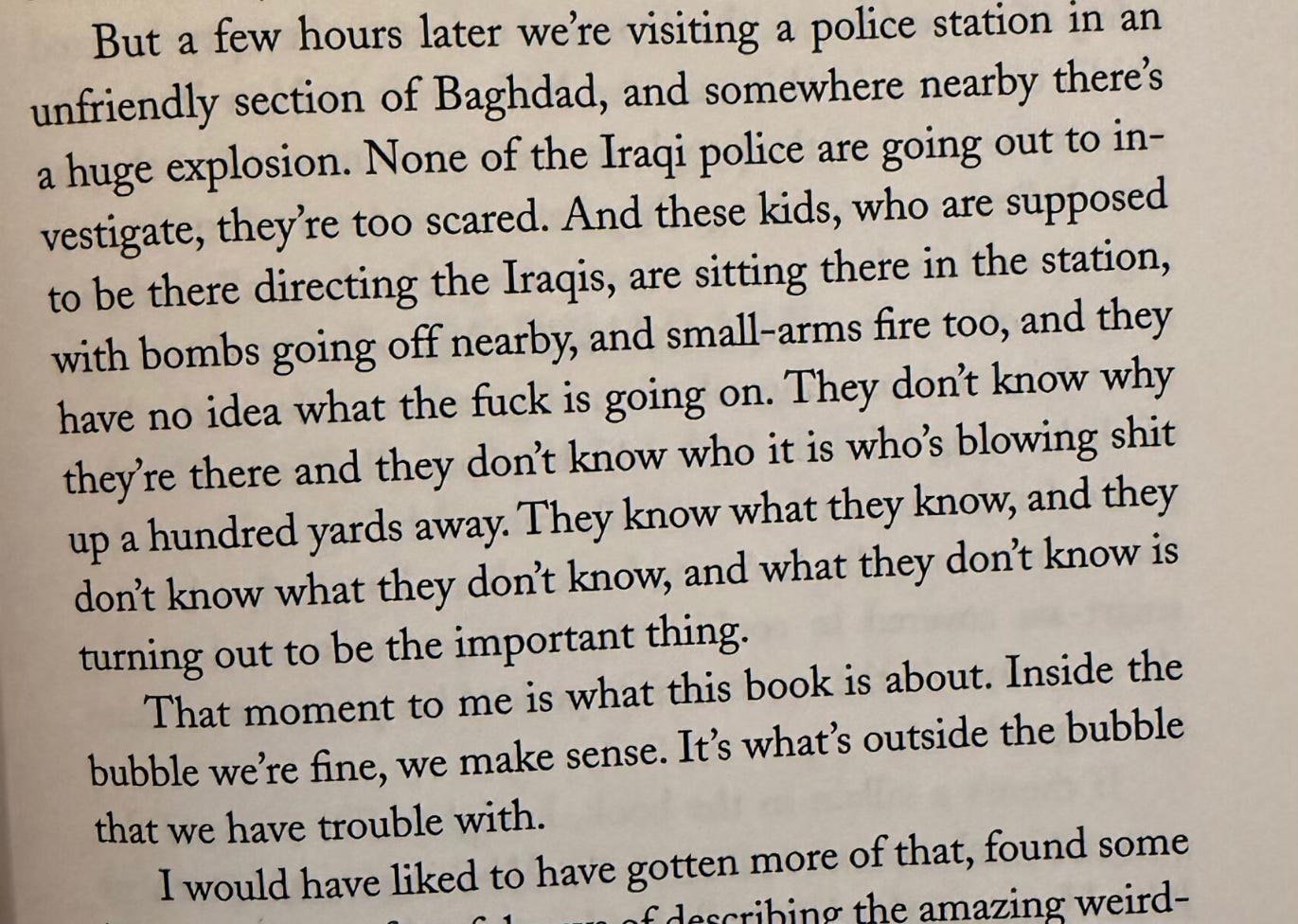
What I Believe, and Why It Matters
I have long believed — and said plainly, in professional and private company — that the wars my generation was sent to fight were financially motivated. Not cynically, in the sense of cartoon villains rubbing their hands together, but structurally and architecturally. The wars served economic interests that were never disclosed to the people sent to bleed for them.
This belief is not peripheral to my professional life. It is my professional life.
All of the searching for answers on why the world is the way it is, has led me to a point where I am qualified in a professional capacity to trace financial networks and map the architecture of money. The architecture I am referring to is how it moves, who benefits, and what it obscures. My professional work is currently not on a large geopolitical scale as right now I choose to work with individuals and small-mid sized businesses instead of governments and corporations. However, my writing and analysis focuses on geopolitics because the big picture helps my clients and more importantly it helps me. The writing I do for Immaculate International on topics such as Iranian financial architecture, Iraqi PMF financing, hawala networks, the petrodollar transition etc, is not abstract geopolitical analysis for me. It’s personal. It is, in the most direct sense I know, me trying to understand why my friends died.
I want to be precise about something, because it’s easy to misread.
I am not bitter that my war was financially driven. I am a generally happy person and you’re not going to find me to be the stereotypical disgruntled veteran in the woods with a bottle of Jack Daniels sleeping in a camper (mostly because I hate bugs).
I understand that empires have fought over resources since before Rome. The Crusades, the East India Company, the Scramble for Africa all show that the fusion of military power and economic interest is older than the nation-state itself. A soldier in the Roman legions wasn’t naive about why Caesar needed Gaul. There is something almost clarifying about understanding war in those terms. It puts you in a long, grim tradition of people who served something larger and more complicated than the story they were told.
What I am is resentful of the lie.
The Specific Violence of Deception
There is a meaningful distinction between hardship and betrayal.
Soldiers are among the most adaptable human beings on the planet. They endure cold, heat, boredom, violence, separation, grief, and bureaucratic absurdity with a kind of operational stoicism that civilians find hard to understand. The reason is simple: they have a why. Victor Frankl identified it in the concentration camps of Auschwitz. The military has always known it intuitively. A soldier who understands the purpose of the mission can endure almost anything the mission requires.
When you take away the why and when you reveal, years later, that the why was manufactured, that the intelligence was shaped, that the threat was exaggerated, that the decision had already been made and the public case was constructed retroactively, you do not just cause disappointment. You retroactively invalidate the suffering. You make the sacrifice meaningless not by disrespecting it, but by revealing that it was procured under false pretenses, which in and of itself violates the christian notion of a just war doctrine, and I would argue the soldier’s natural conscience.
That is a specific and serious form of violence against the people who served.
And it doesn’t end at homecoming. It follows veterans into civilian life as a corrosive compound: grief layered under betrayal, layered under the institutional insistence that the narrative is still basically correct, that the intelligence was just “imperfect,” that everyone acted in good faith.
The Financial Architecture of Iraq
This is not conspiracy. This is documented history that is simply rarely assembled in one place.
The Iraq War was preceded by a decade of sanctions that had catastrophically failed to dislodge Saddam Hussein while killing an estimated half-million Iraqi children — a toll that then-Secretary of State Madeleine Albright famously told 60 Minutes was “worth it.” The sanctions regime had also, not coincidentally, locked Western oil companies out of one of the world’s largest proven reserves.
Iraq sat on approximately 115 billion barrels of proven reserves in 2003 — second in the world behind Saudi Arabia. Under Saddam, those contracts went to Russian, French, and Chinese firms. The post-invasion restructuring of Iraqi oil contracts represented a multi-trillion dollar reorientation of energy revenue.
In 2000, Saddam Hussein made a decision with enormous symbolic and practical implications: he began denominating Iraqi oil sales in euros rather than dollars. For students of petrodollar architecture, this was a direct challenge to the foundational mechanism by which the United States maintains dollar hegemony, ie., the requirement that oil be purchased in dollars, which forces every oil-importing nation on earth to hold dollar reserves and absorb American debt. Iran later floated similar moves. Libya under Gaddafi proposed a pan-African gold dinar for oil transactions. Each of these leaders ended up dead or deposed. This is not coincidence. It is the operating logic of an empire protecting its monetary architecture.
None of this appeared in the Authorization for Use of Military Force.
The public case for the Iraq War rested on weapons of mass destruction that did not exist, aluminum tubes that were not centrifuges, and a meeting in Prague between Mohammed Atta and Iraqi intelligence that the CIA itself disputed. The Downing Street Memo which was a classified British document leaked in 2005, stated plainly that “the intelligence and facts were being fixed around the policy.” Fixed. Around. The policy.
The decision had been made. The case was constructed afterward. The soldiers were the instrument.
What This Does to a Person
I’ve been doing financial crime investigation and intelligence analysis for long enough to know how institutional deception operates at scale. It is rarely a single lie, clearly told, by a single actor who knows exactly what they’re doing. It is more often a system of incentives that rewards certain framings, punishes inconvenient analysis, and produces, through a thousand individual accommodations, a collective product that bears no resemblance to what actually happened.
And it doesn’t make the downstream damage any less real.
PTSD is not just about what you saw. It’s about what you can no longer believe. When the structures of meaning that gave your sacrifice its shape are revealed to have been constructed or when the institutions you trusted with your life are shown to have been, at best, reckless with the truth, the wound isn’t just psychological. It’s epistemological. You don’t know what to believe anymore. You don’t know what was real.
This is, I think, a significant and underappreciated driver of the veteran mental health crisis. It is not simply that combat is traumatic. It is that combat undertaken for disclosed reasons, processed in community, held in a coherent narrative framework, can be survived. Combat whose meaning was retroactively dissolved is something harder to recover from. But somehow this is missing from the #22aday, and the many corrupt nonprofits that profit off my generation’s collective pain.
Why I Do This Work
Lux in Tenebris. Light in darkness. It’s the motto I operate under, and it is not merely branding.
The financial architecture of war as in the way money moves through conflict zones, the networks that finance armed groups, the mechanisms of sanctions evasion, the intersection of state power and illicit capital, is not an abstraction to me. It is the thing I should have been able to study before I deployed. It is the analytical frame that would have given me a more honest picture of what I was walking into.
I can’t give that to the younger version of myself, or to the friends I lost. But I can do the work now. I can map the networks. I can trace the money. I can publish what I find.
Not out of bitterness. Out of the conviction that understanding the financial logic of power is not optional for people who want to operate with integrity in the national security space, which trickles down to the private sector.
Empires have always fought over money and resources. That’s not the scandal.
The scandal is that they told us it was something else.
Amanda D. Appi, CFE, is the founder and principal of Immaculate International, a veteran-owned boutique intelligence firm. She served as a Military Police officer with the U.S. Army, including a combat deployment to Iraq from 2008–2009. She holds the CFE credential and is a licensed private investigator.
#ptsd #combatveteran #Iraq #OIF #financialwarfare #petrodollar #thegreatderangement #rustamiyah